
Hiring activity is a fantastic signal to assess which startups have the most traction. Unfortunately, tracking hiring information historically has been impossible.
Here’s why tracking hiring activity is so painful today.
Suppose we gave you a list of 100 Silicon Valley tech companies who recently raised a Series A. And then suppose we asked you to identify which ones are hiring the fastest, and in particular, which are scaling their sales or engineering teams. And by the way, we need it by tomorrow by 9:00 AM. How would you do it?
Here’s how the process looks:
- Cancel your evening plans – First, you’d call your friends and cancel the plans you’d made for that evening because “your a-hole boss just dumped an insane amount of grunt work on your desk”
- Get coffee and start manually scouring websites – Then you’d grab a cup of cold brew and start visiting company websites one-by-one and looking for their jobs page. If you’re particularly industrious, you’ll visit a couple of job search boards and search for the company name to ensure you find jobs that might not be listed on their websites.
- Create a spreadsheet – If your boss wanted it to be really “data-driven”, you’d start noting the # of jobs at each startup in a spreadsheet. And maybe eyeballing the breakdown between sales vs. non-sales roles.
- Waste a lot of time – Assuming each company takes 5 minutes to analyze – and that you don’t eat, need to pee and that you’re as alert at company 63 as you were at company 1 – you’ll have spent 500 minutes on this mindless exercise (8.33 hours)
- Present incomplete data – You’ll present your findings to your boss the following morning.
- Boss checks it and finds it is incomplete – She may go visit a couple of companies on her own and see more jobs posted that what you noted because the startup posted new jobs the day after you had finished your analysis (oh crap)
Yes – this is the pain you would endure.
And if you needed do this monthly, God speed.
The worst part of this process, beyond it’s incredible consumption of time and complete lack of scalability, is that at the end the data set is not even complete. And instead of spending your time in more valuable ways, such as researching or building relationships with the startups, you’re stuck doing hours of manual grunt work.
Tracking startup hiring activity doesn’t have to suck
We are about to rock your world.
Yes – really.
Let’s take the same example. Series A tech companies in Silicon Valley. We go to CB Insights deal search and see that in the last year, there have been 358 deals that meet this criteria.
So we’re going to expand this beyond just looking at 100 companies as the image from Deal Search illustrates below.

From here, we’re going to visit the Performance Metrics filters and use the new Hiring filters and look within this list of companies to understand which of these companies has at least 10 jobs and fewer than 100 open jobs right now. We can also search to see who has had 10 open jobs in the last 6 months.
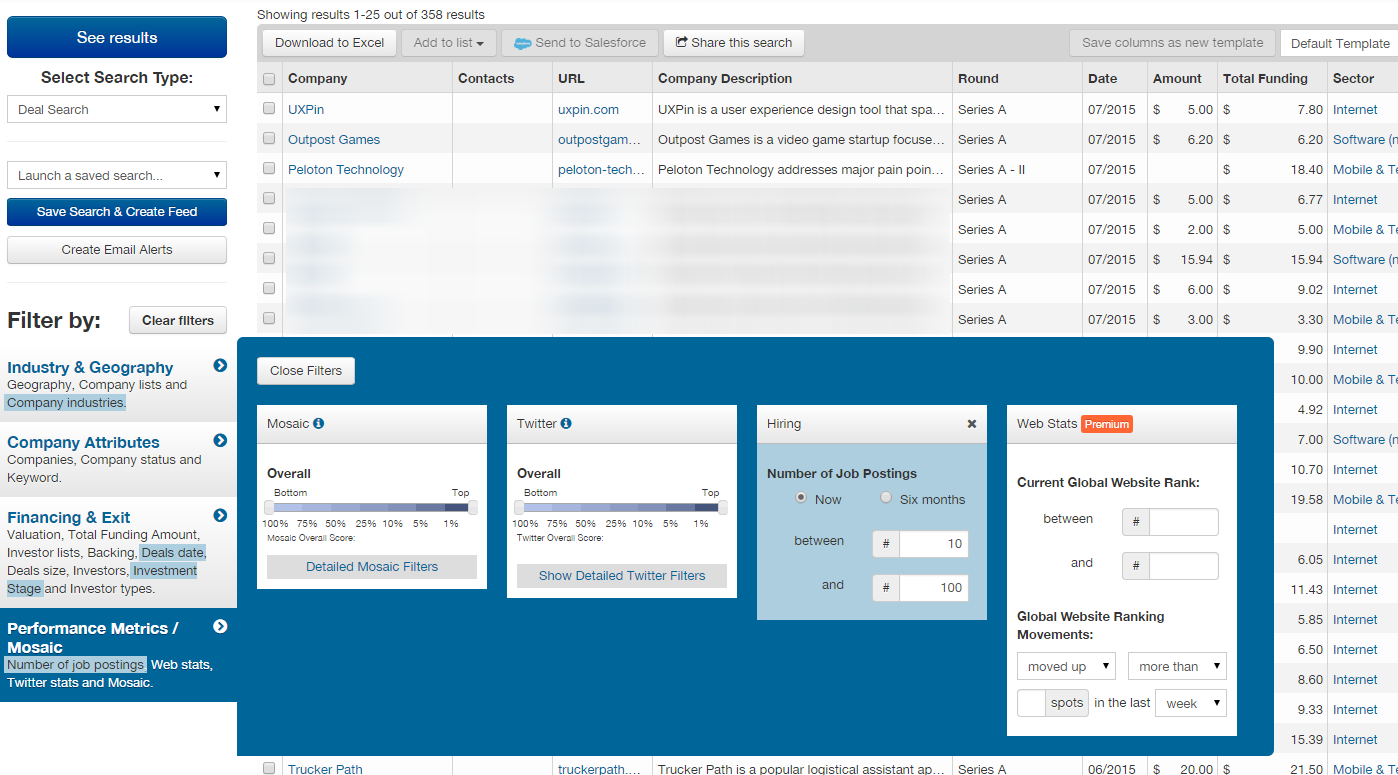
This narrows the list down from 358 to 58 as the screenshot below illustrates.
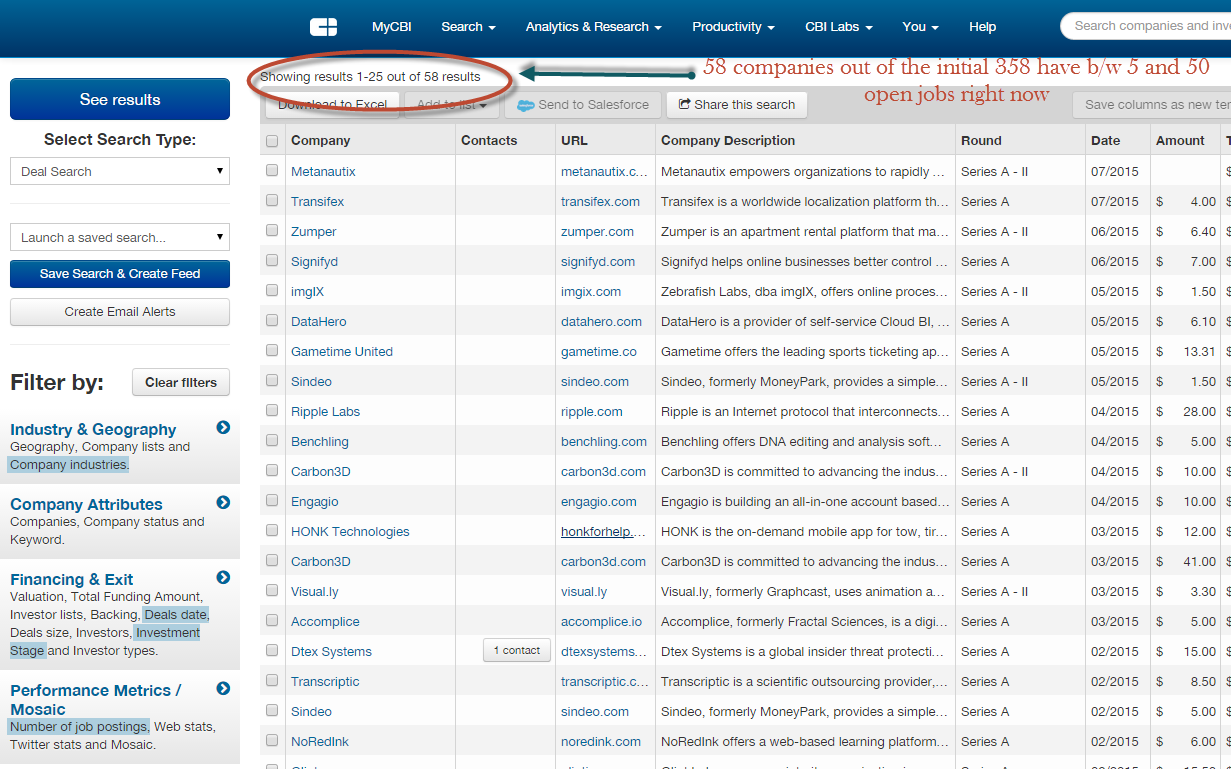
With the list created, you can dig into a company’s profile to see where they are hiring.
From these results, we’ll click on Ripple Labs to visit its company profile and specifically the new Jobs tab which will reveal their hiring activity over time so you don’t only see the open jobs today but their open jobs over time so you can see if their hiring momentum is getting stronger.

On this jobs tab, if you click on any graph bar, it’ll reveal stats about each company’s hiring activity.
In particular, it’ll show you how the jobs are broken down by both function and seniority as the screenshot below illustrates.

You can also search for keywords within the job and click on links to open the actual job postings.
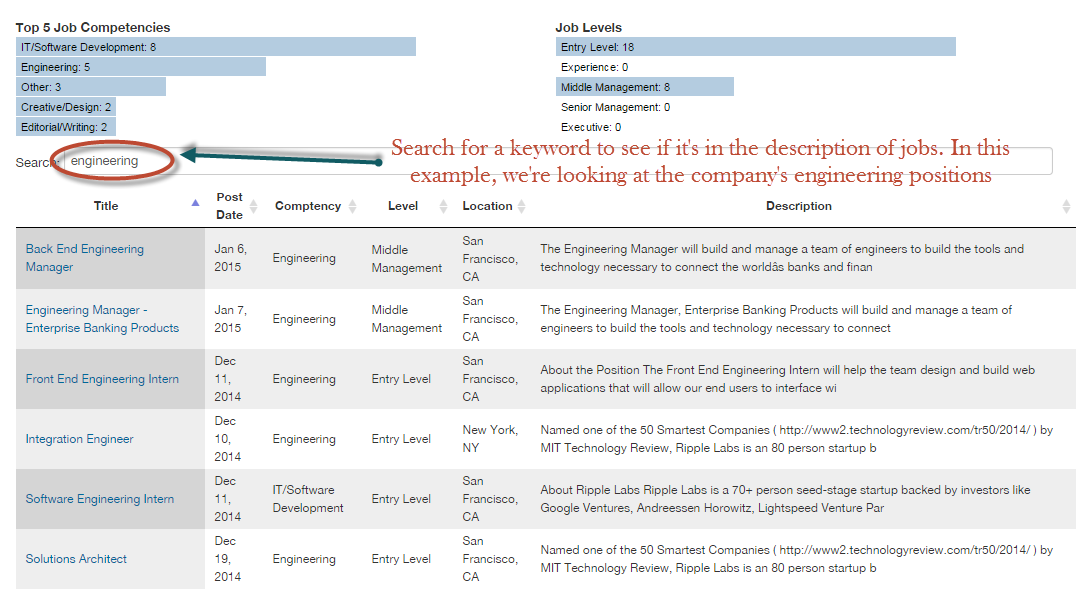
This whole process took <5 minutes.
So to recap, let’s compare the two methods: manual versus CB Insights:
- Manual – Incomplete data. Spent at least 8 hours. Ruined evening plans with friends.
- CB Insights – Complete data. Higher quality data. Done in < 5 minutes. Don’t have to blow off your friends.
And this doesn’t even include other powerful ways to further filter your list using CB Insights such as looking at which companies are generating the most chatter on Twitter.
Hiring data is currently available at the Insights subscription level.
Set up a free trial below to CB Insights if you’d like to make your life more efficient and identify quickly growing companies using hiring data.