
The combination of the HITECH Act and the Affordable Care Act have spurred a wave of change that the US healthcare system hasn’t seen in decades. Collectively, the changes have brought about “Healthcare 2.0,” where the incentives for care and new digital tools have enabled an overhaul of many existing processes. Changes in primary care, health insurance, and drug purchasing are slowly creating a new healthcare-delivery landscape.
In the webinar, I point to where opportunities exist today, and what the future of care might look like.
The full webinar dives into detail on each of these points below, but these are four of the overarching themes that span many of the moving parts in the health care system:
New Healthcare Businesses Are Internalizing More Functions
Many private companies that are raising money to build new healthcare institutions are differentiating themselves by offering a more narrow choice in services but owning more parts of their “stack,” in order to speed up processes and reduce costs. Even larger companies are trying to move into different layers of healthcare to funnel more potential customers to themselves. Some example of companies that are internalizing more functions:
- One Medical Group: Offers higher quality primary care through it’s concierge medicine-style business, but also has developed it’s own EMR (electronic medical records) platform and offers on-site lab testing.
- Oscar Health Insurance: Mario Schlosser described Oscar as a “full-stack insurance company” at our Future of Fintech conference, because they don’t outsource services like claims processing, utilization management, etc. It also looks like they could be entering primary care itself based on job postings.
- CVS: A more established company, drugstore chain CVS is looking to move from just selling goods and pharmacy services, and into providing healthcare more directly, evidenced by investments they’ve made in private markets like myhealthteams, their aggressive expansion of retail clinics, and products coming out of their Digital Innovation Lab.

Advantages Of Tech Enablement Are Hitting Healthcare
We’ve seen disruption in virtually every other industry as tech penetration increases and the cost of goods and services scale down. Healthcare has been slow to adopt those principles, but many new businesses are being funded and built where tech is a critical component of scaling up a service. Some examples:
- Removing the costs of brick-and-mortar: Amazon was a pioneer because the company proved that you didn’t need a physical store to sell things. New companies like Pillpack, Dispatch, and Sherpaa are building businesses from the ground up, which eliminate the brick-and-mortar aspect entirely, allowing them to scale up care faster and scale down costs.
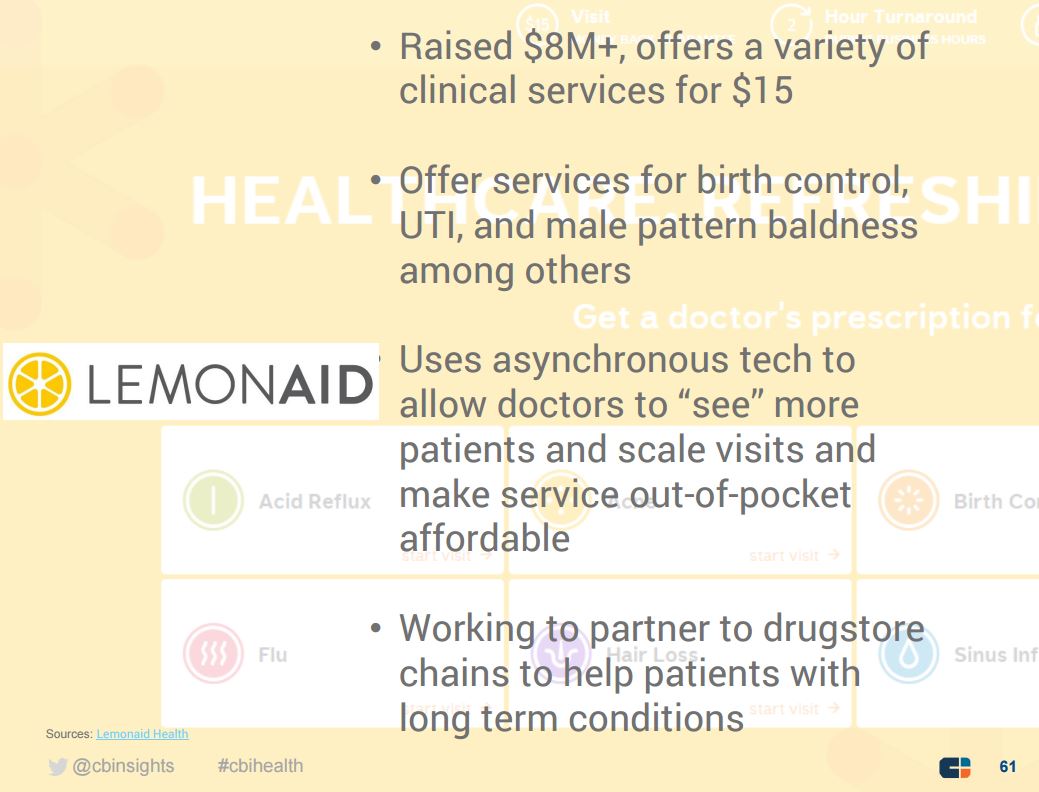
- Asynchronous care: Most patients don’t actually need to be physically seen for diagnosis, especially if it’s a common affliction. By removing the face-to-face part of an interaction, doctors can “see” many more patients in a shorter time, and therefore scale down the cost of the service. Companies like Lemonaid Health do this.
- Location-agnostic: People in rural areas and people that have mobility issues (e.g., elderly populations) have issues accessing care and are also populations more at risk for expensive hospitalizations. Tech enables these people to get care wherever they are, reducing costs for the system as a whole.
Employers Act More And More Like Insurance Companies
Employers already pay a large portion of healthcare costs, and premiums continue to increase. Because of this, more and more companies are turning to self-insurance as a means of mitigating this expenditure. In self-insurance, employers actually take on the financial risk of insuring their employees, rather than outsourcing that to health insurers. While this was previously more popular in larger employers, we’re starting to see an emergence in small and mid-size companies self-insuring as well.
With employers more financially incentivized to keep their employees healthy, many of them are employing startups to help manage population health and bring services on-site. A host of startups are unbundling the functions that health insurance provides and appealing to these employers’ health/wellness budgets. That includes increasing the leverage power of small companies, who typically don’t have the same negotiating power as larger employers due to smaller employee pools. Companies like Collective Health and Blink Health are using tech as a means of bundling leverage from smaller employee pools to negotiate on behalf of these smaller companies for reduced prices on medical goods and services.

Patient Triaging + More Options For Care = Lower Cost
More data has helped assess which patients are more at risk for potentially expensive hospitalizations, while at the same time new care alternatives are filling a critical gap to allow options for people to receive care based on their severity. Urgent care clinics, retail clinics, and telemedicine can provide care to patients where you once had to go to a overburdened primary care physician and or the over-expensive ER. By funneling people into the most appropriate setting for their care, we provide better cost care and lower the friction to see a doctor, which overall reduces hospitalizations.
 While these are some of the overarching themes, we dive more into specific companies and areas to identify potential opportunities in the webinar. Get the slides and recording by signing up here, and get access to our private market database to identify which companies are disrupting here by signing up below.