
Recently Good Eggs, a startup that brings farmer’s markets online and has raised nearly $30M in venture funding, announced it was scaling back and closing its operations in New York, Los Angeles, and New Orleans to refocus on its first market, San Francisco.
We used CB Insights data to look at the geographic reach of 13 of the top food-delivery startups, and analyzed this footprint to gauge whether or not some of the startups might be at risk of overextending themselves in the race to gain market share in the top metros.
Geographic Reach
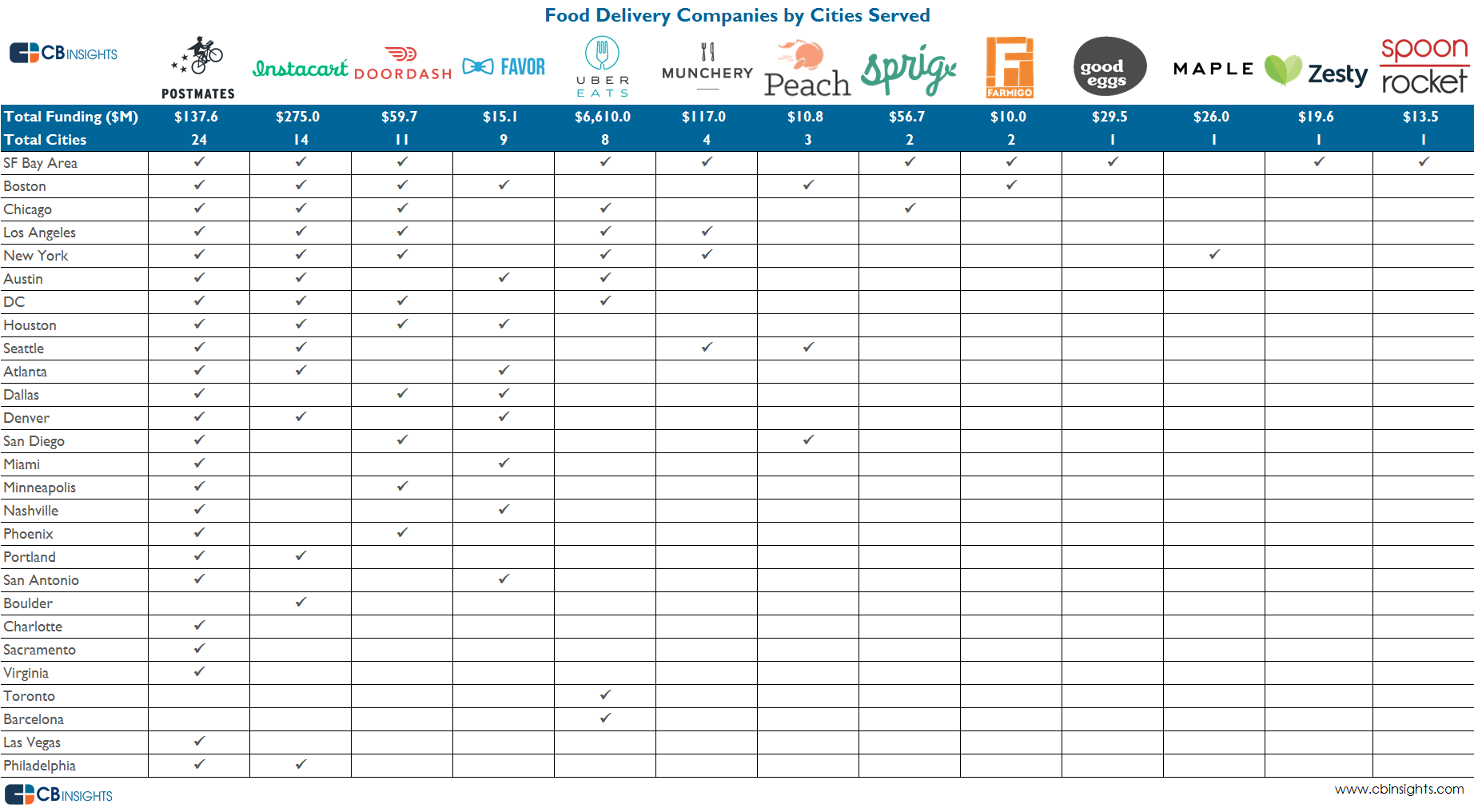
We first looked at some of the notable US startups focusing on food delivery and analyzed their geographic reach based on the number of cities they were operating in, according to their websites.
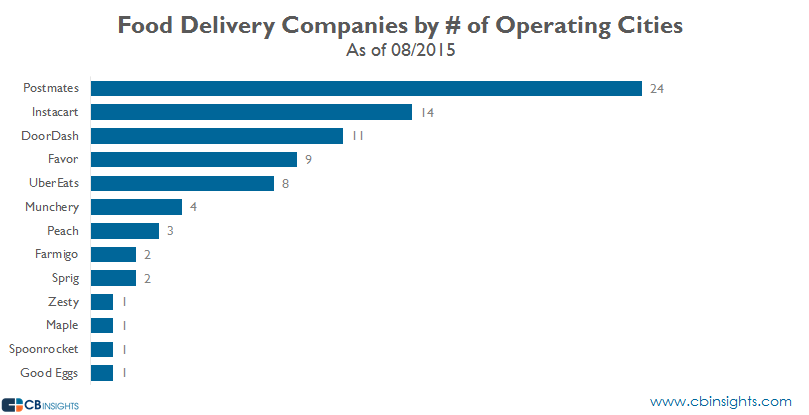
The chart below provides an alternative view of startups by the number of cities in which they are operating in.
Growing Pains?
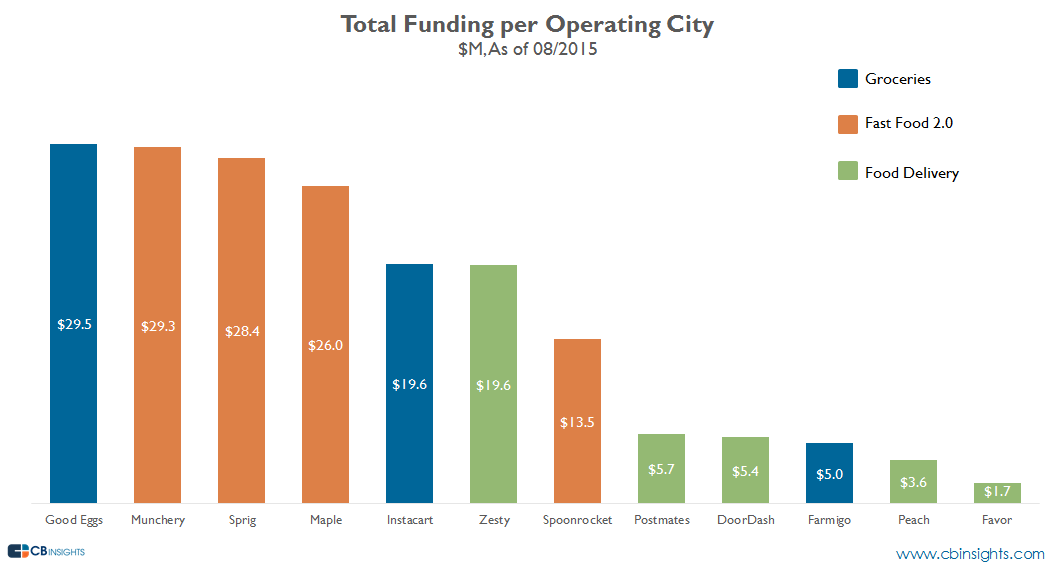
Then we asked, could the type of growing pains that Good Eggs is experiencing be felt soon by food-delivery counterparts? As expanding geographic reach often equals expanding overall costs, funding plays a key role for these companies. To identify a few startups that could be at risk of overextending themselves, we analyzed the total funding per operating city for each company. The chart below shows the results of that analysis. A few notes:
- Comparing similar business models, food delivery company Postmates, is operating in a whopping 24 cities, which with their impressive $137.6M funding puts their funding per city at $5.7M. This is similar to DoorDash which with $59.7M raised and 11 cities is at $5.4M per city. However, Favor, a similar, yet earlier-stage Texas-based logistics company with a focus on food delivery, is operating in 9 cities, bringing their funding per city to $1.7M, the lowest total of all the startups we analyzed. Other early-stage startups such as Peach recently expanded into new cities, in conjunction with a fresh $8M in Series A financing.
- When we look at prepared meal delivery (which we call Fast Food 2.0) companies, Munchery, Sprig, and Maple all have comparable funding-per-city figures at $29.3M, $28.4M, and $26M respectively. Meanwhile, the possibly struggling SpoonRocket, has a $13.5M funding to city ratio (which would be just $6.75M had it not recently shut down its Seattle operations).
- Good Eggs currently has the highest funding per city at $29.5M after shutting down in 3 other cities. However before the scaling back of operations, they would have sported $7.4M in funding per city, putting them towards the bottom half of the group.
- Finally, a giant looms over the overcrowded food-delivery space: UberEats (not included in the chart below). It is currently operating in 8 cities, including 2 internationally,Toronto and Barcelona. UberEats has a large war-chest for both it’s main on-demand car business, as well as any other future logistics ambitions.
Want more data around food tech startups? Login to CB Insights or sign up for free below.
If you aren’t already a client, sign up for a free trial to learn more about our platform.