White paper
CB Insights Mosaic Score
How data science-backed signals can successfully
predict the birth of unicorns


Fortune favors the data-driven. The top
10 Fortune 500 firms trust CB Insights.

Fortune favors the data-driven. The top 10 Fortune 500 firms trust CB Insights.
Executive summary
Top venture investors are often viewed as the best indicator of which private companies will succeed.
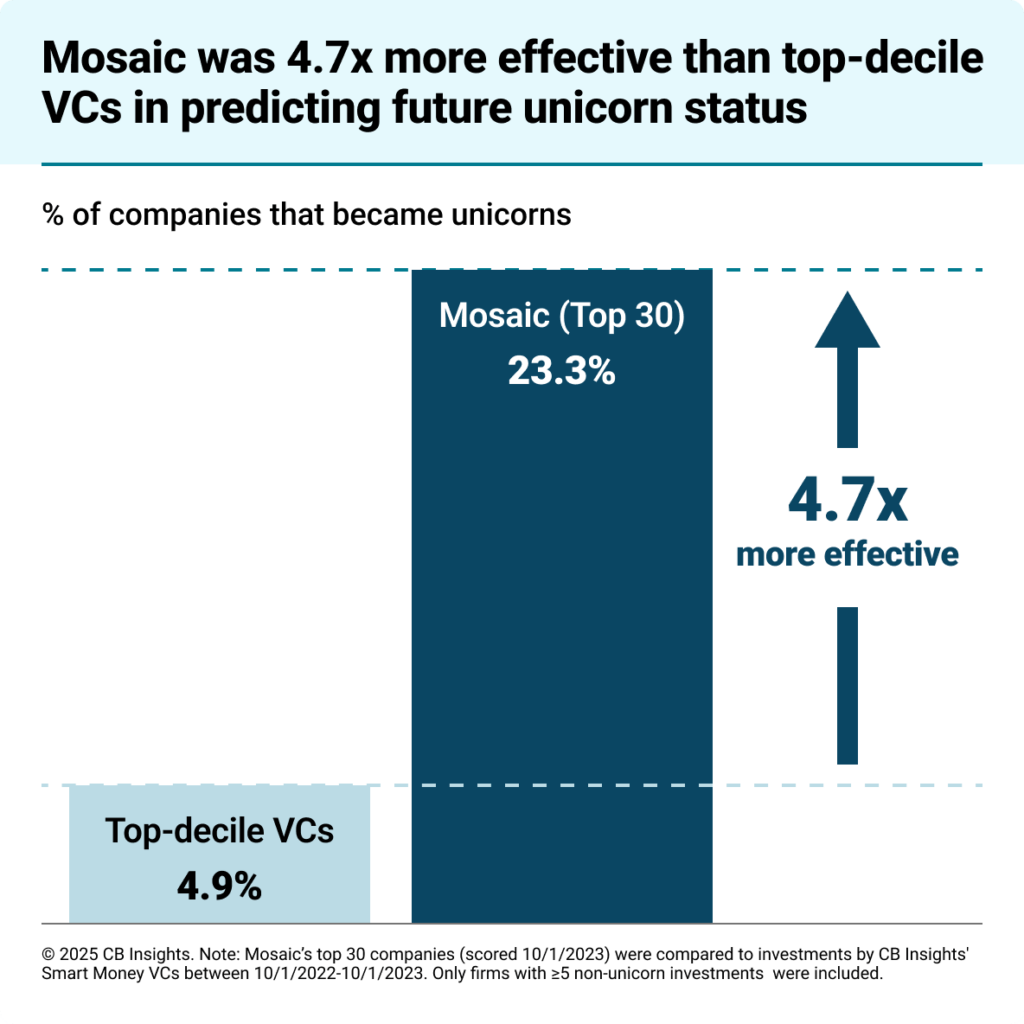
This paper shows how CB Insights’ algorithmic Mosaic score was 4.7x more predictive than top-decile VCs when projecting which private companies are likely to become unicorns.
Predictive intelligence, via the Mosaic score, is therefore a more reliable proxy when evaluating, sourcing and partnering with private companies.
Overview
Private company analysis is still dominated by intuition and incomplete information. Most firms rely on lagging indicators—like funding rounds or media coverage—as proxies for company health and potential.
CB Insights’ Mosaic Score solves this challenge, applying algorithmic analysis and AI to quantify company health across forward-looking indicators.
In a two-year retrospective study of 150,000+ private companies, Mosaic demonstrated that systematic, data-driven evaluation can outperform even the world’s top venture investors.
Key Findings
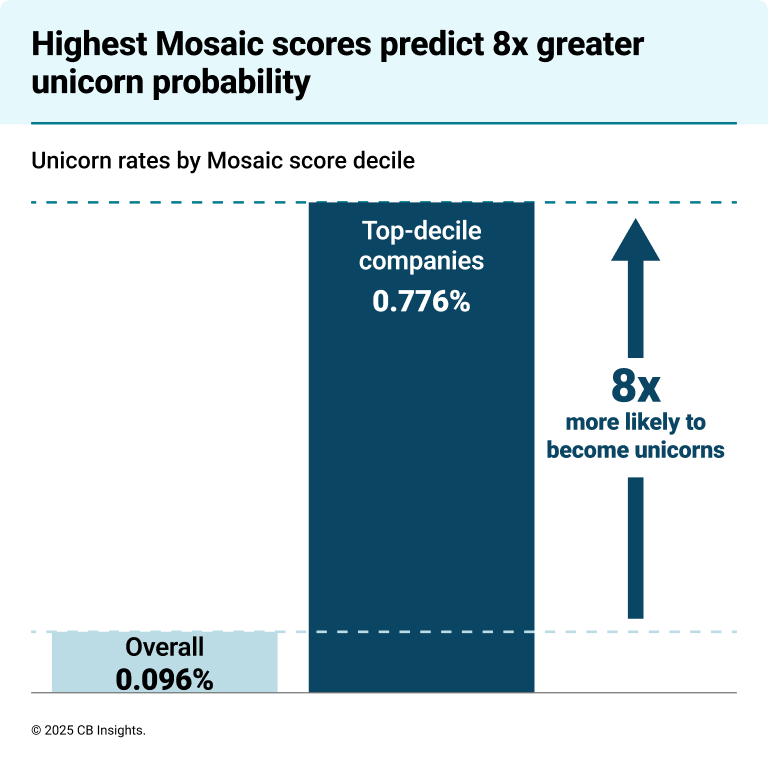
- 8.06x predictive lift: Companies in the top 10% of Mosaic scores were 8.06x more likely to become unicorns than the overall population.
Non-unicorns in the top 100 Mosaic score bracket were 155x more likely to become unicorns in the next 2 years. - Outperforms elite VCs in predicting success: Mosaic’s algorithmic scoring outperformed 24 of 24 top-tier venture capital firms in identifying
future unicorns. - 4.7x hit rate advantage: Mosaic delivered 4.7x the median VC’s success rate, with a 23.3% unicorn rate among its top 30 companies.
The results show that data-driven models trained on forward-looking inputs can identify strong performers earlier and with greater consistency than traditional evaluation methods.
Building on this foundation, Mosaic provides a structured framework for identifying and prioritizing companies with the highest potential for growth and market impact.
This paper presents an empirical evaluation of the CB Insights Mosaic Score using two years of outcome data across more than 150,000 firms.
The analysis assesses Mosaic’s ability to identify future high-performing companies and benchmarks its predictive accuracy against leading venture capital investors.
What is Mosaic?
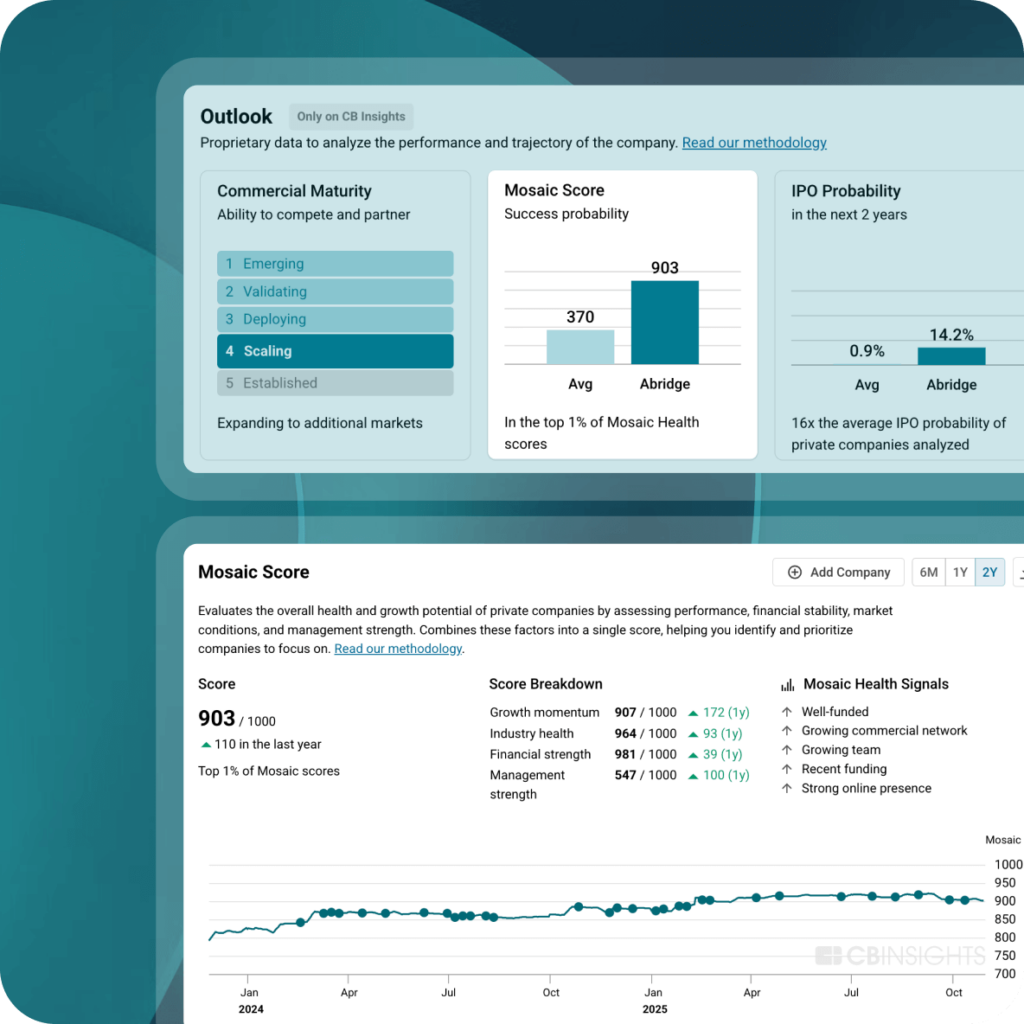
CB Insights’ Mosaic score is an algorithmically-driven health score for private companies—an index of 0–1,000 that helps indicate which startups are most likely to achieve unicorn status and deliver exceptional returns. Mosaic is dynamically calculated across four forward-looking dimensions:
Growth Momentum (50%), Financial Strength (40%), Industry Health (5%), and Management Strength (5%).
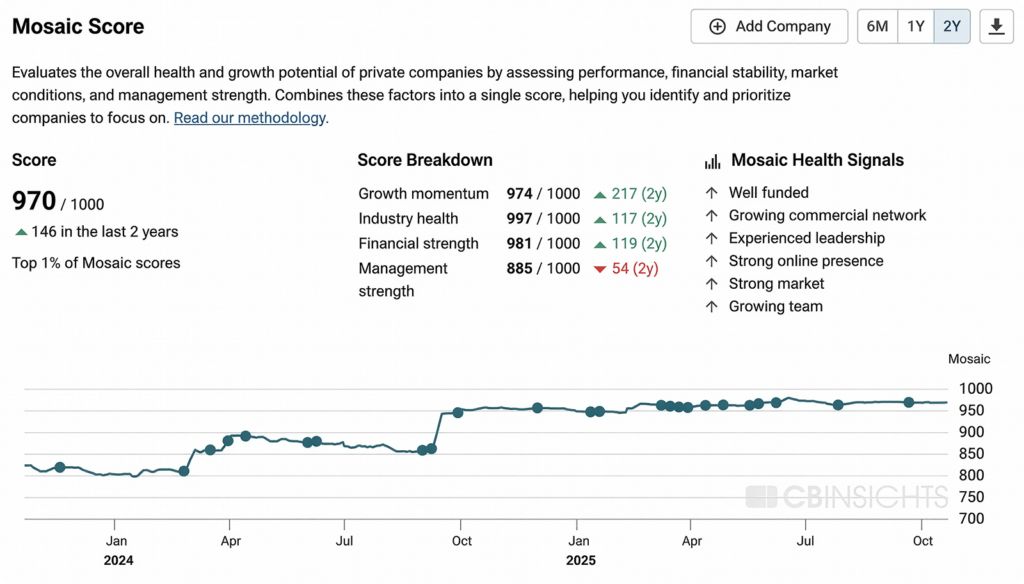
By combining these dimensions into a single, comparable metric, Mosaic enables both universe-wide and within-sector ranking of companies. This is particularly important in high-growth areas such as AI, where entire markets are expanding rapidly. Within-sector comparisons allow for more nuanced evaluations of companies competing in similar conditions, highlighting those with exceptional momentum or resilience.
The result is a consistent framework for identifying companies that exhibit early indicators of sustained growth—before those signals become visible through traditional metrics.
Mosaic Sub-Indices
- Growth Momentum (50%) – Measures the rate and persistence of a company’s growth using signals such as hiring trends, digital engagement, and business traction.
- Financial Strength (40%) – Evaluates capital efficiency, funding dynamics, and indicators of financial stability.
- Industry Health (5%) – Assesses the overall strength and trajectory of the company’s operating market, including investor activity and ecosystem expansion.
- Management Strength (5%) – Captures the experience, stability, and prior success of the leadership team.
Together, these dimensions produce a standardized, data-driven view of private company performance and potential.
The following section outlines how Mosaic’s predictive performance was evaluated using a two-year retrospective analysis and benchmarking against leading venture investors.
Methodology
Companies were segmented into 10% percentile bands (P00-P10, P10-P20, …, P90-P100) based on their Mosaic score on October 1, 2023.
We employed two complementary analytical approaches to evaluate Mosaic’s predictive performance:
- AUC (“Area Under the Curve”) Analysis: The AUC score measures how well the model distinguishes between positive and negative outcomes in a binary classification. In this analysis, the positive class represents companies that became unicorns, while the negative class includes all others. The “curve” refers to the ROC curve, which plots true positive versus false positive rates across thresholds. The AUC summarizes overall model performance, where 1.0 indicates perfect prediction and 0.5 reflects random chance.
- Percentile Comparison: Success rates were measured across Mosaic score bands to observe how predictive outcomes vary by percentile.
We conducted two independent analyses to assess Mosaic’s predictive capability across different outcome types:
- Unicorn Formation Analysis: Examined companies that reached a $1B valuation within 24 months after the Mosaic scoring date. We analyzed all 150,500 companies that were not yet unicorns as of the scoring date, regardless of whether they had disclosed valuation data, to determine whether Mosaic could predict future unicorn births across the broadest possible population.
- Smart Money VC Comparison: To benchmark Mosaic’s performance against elite human judgment, we compared Mosaic’s top-scoring companies against investment portfolios from the 24 venture capital firms featured in CB Insights’ Smart Money 2025 list with 5+ investments in the previous year. We identified all investments these firms made between October 1, 2022 and October 1, 2023 in companies that were not unicorns at investment time, then tracked whether these companies achieved unicorn status over the subsequent 24 months through October 1, 2025.
The evaluation framework employs a retrospective analysis approach with temporal integrity safeguards to ensure no forward-looking bias, using only historical data available at scoring time. All outcomes were tracked over exactly 24 months following the scoring date to ensure temporal precision.
Analysis
In October 2025, we examined 151,679 companies with Mosaic scores, using their scores from two years prior (October 1, 2023) to assess Mosaic’s ability to predict critical success outcomes over the subsequent 24-month period:
- Unicorn formation: Companies in the top 10% of Mosaic scores were 8.06x more likely to achieve unicorn status, capturing 80% of all future unicorns while requiring evaluation of just 10% of companies. Among the top 100 highest-scoring companies, 15% became unicorns—a 155x improvement over the baseline rate (analysis of 150,500 non-unicorn companies, AUC: 0.922)
- Outperforming elite investors: Mosaic’s top 30 companies achieved a 23.3% unicorn rate, outperforming all 24 Smart Money venture capital firms in scope and delivering 4.7x the median VC’s hit rate over the same period
This predictive power enables investment teams, corporate development professionals, and business development leaders to cut through noise and focus resources on the highest-potential opportunities. Instead of conducting manual evaluations across hundreds of prospects, teams can prioritize due diligence on top-scoring companies that fall within their target parameters.
Key Finding #1: Unicorn Birth Prediction
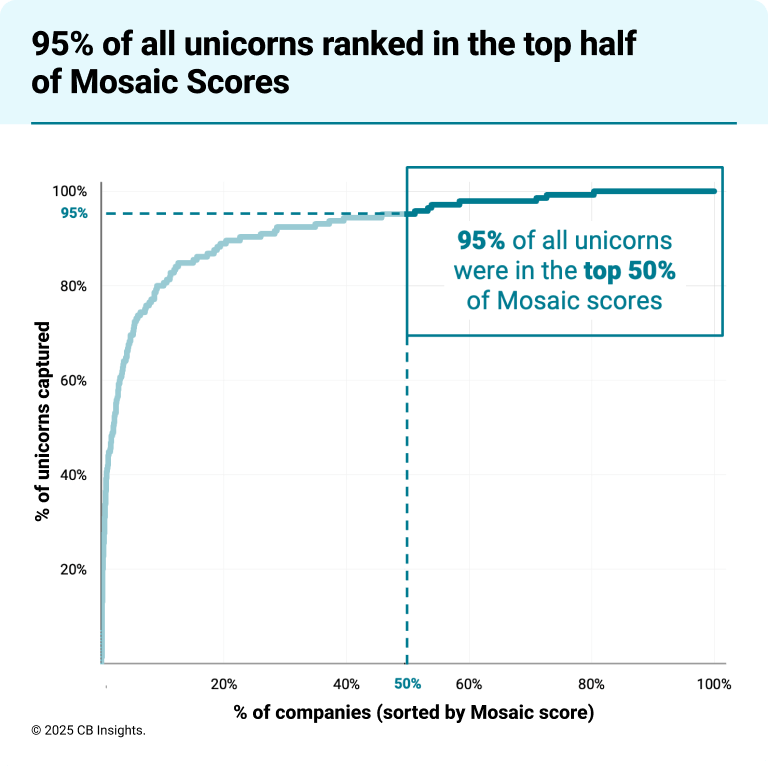
This analysis examines whether Mosaic can predict which companies will achieve unicorn status (≥$1B valuation) after the scoring date of 10/1/2023. We included all 150,500 companies that were not yet unicorns as of the scoring date, providing the most comprehensive assessment of Mosaic’s predictive power across the entire non-unicorn population. Within 24 months, 145 companies (0.10%) achieved unicorn status. Of these 145 unicorns, 80% (116) had Mosaic scores in the top 10th percentile of the overall population.
Key Metrics:
- Overall Unicorn Rate: 0.10% (145 out of 150,500 companies)
- Top Decile Unicorn Rate: 0.78% (116 out of 14,943 companies)
- Top 100 Companies Rate: 15.0% (15 out of 100 companies)
- Lift Factor: 8.06x (top decile vs. overall population)
- Lift Factor (Top 100): 155.69x (top 100 vs. overall population)
- Winner Capture: Top 10% of scores captured 80.0% of all unicorns, top 20% captured 84.8%, top 50% captured 95.2%
- Top vs Bottom Decile: Infinite lift (0.78% vs 0.00% unicorn rate—bottom decile had zero unicorns)
- AUC Score: 0.922
- Score Range: Top decile scores ranged from 608-933, while bottom decile scored 3-165
Interpretation: Companies in the top 10% of Mosaic scores were 8.06x more likely to achieve unicorn status than the overall population. The notable AUC of 0.922 demonstrates strong discriminatory power in separating future unicorns from the broader market. The clear monotonic relationship across percentile bands—with each successive decile showing higher unicorn rates—demonstrates that Mosaic captures fundamental drivers of strong outcomes rather than random noise.
The gains analysis reveals significant winner identification: by evaluating only the top 10% of companies by Mosaic score, investors would capture 80.0% of all future unicorns. Expanding to the top 20% captures 84.8% of unicorns, while the top 50% captures 95.2%—demonstrating that Mosaic identifies nearly all breakthrough companies within the top half of scores. The fact that the bottom decile produced zero unicorns while the top decile produced 116 shows that Mosaic distinguishes high-potential companies from those with lower near-term unicorn likelihood.
The predictive power becomes even more pronounced at the very top of the score distribution. Among the top 100 highest-scoring companies—representing just 0.07% of the population—15 became unicorns within 24 months, a 15.0% hit rate that represents a 155x improvement over the baseline. This demonstrates that Mosaic’s signal strengthens considerably for the absolute highest-scoring companies, enabling investors to construct highly concentrated portfolios with stronger expected performance.
See which companies in your universe
are in Mosaic’s top decile.
Key Finding #2: Outperforming Elite Venture Capital Investors
To benchmark Mosaic’s predictive capability against elite human judgment, we compared its performance to investments made by 24 of the 25 venture capital firms featured in CB Insights’ Smart Money 2025 list—widely recognized as the most successful investors in technology startups. We included firms with 5+ investments in non-unicorn companies during the analysis period. These firms deployed capital into companies between October 1st, 2022 and October 1st, 2023, while Mosaic scored companies as of October 1st, 2023, creating a fair comparison with identical outcome measurement windows.
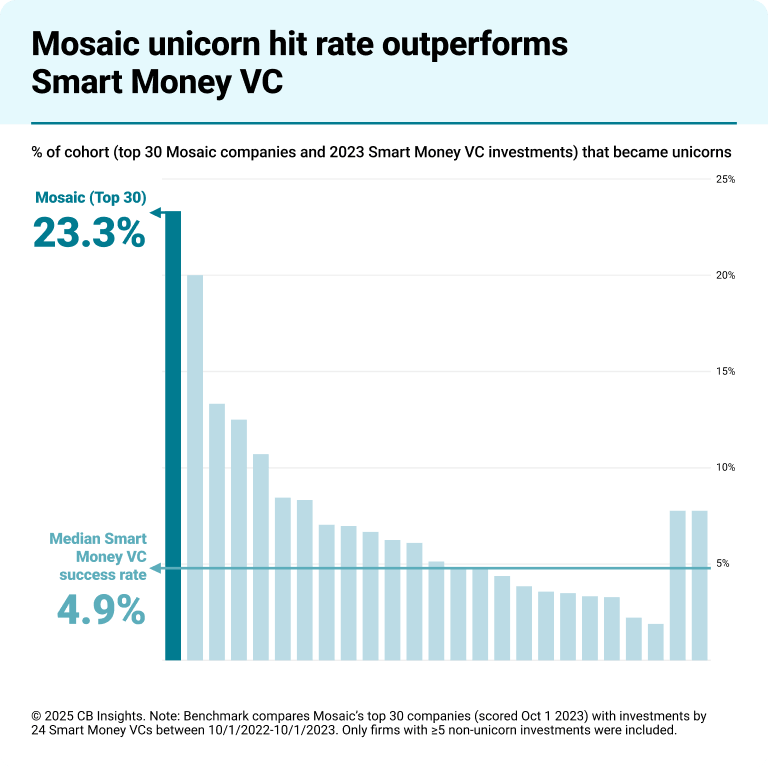
The median Smart Money VC invested in 30 unique companies during this period. For comparison, we examined Mosaic’s top 30 highest-scoring companies and tracked whether they achieved unicorn status over the subsequent 24 months.
Note: Analysis includes only Smart Money VCs with 5+ investments in non-unicorn companies between October 1, 2022 and October 1, 2023. Meritech Capital Partners was excluded.
Key Metrics:
- Mosaic Top 30: 23.3% unicorn rate (7 out of 30 companies)
- Median Smart Money VC: 4.9% unicorn rate (median portfolio: 30 companies)
- Mosaic Advantage: 4.7x higher hit rate than median elite VC
- VCs Outperformed: 24 out of 24 Smart Money firms in scope (i.e., with at least 5 investments in the investment window)
Notable Comparisons:
- Absolute unicorn count: Mosaic’s top 30 companies produced 7 unicorns—more than any individual Smart Money VC. The next best performers (Andreessen Horowitz and Google Ventures) each identified 6 future unicorns, despite deploying capital across 137 and 91 companies respectively.
- vs. Sapphire Ventures (20%, 5 companies): Mosaic’s 23.3% exceeded the best performing VC, which had 1 in 5 investments become unicorns.
- vs. Felicis (13.3%, 30 companies): Mosaic outperformed by 1.75x despite identical portfolio size
- vs. Andreessen Horowitz (4.4%, 137 companies): Mosaic achieved 5.3x higher hit rate than one of the most active investors
- vs. Sequoia Capital (7%, 71 companies): Mosaic delivered 3.3x better performance than the iconic VC firm
Interpretation: Mosaic’s algorithmic approach achieved a 23.3% unicorn rate among its top 30 companies, outperforming all 24 elite venture capital firms on the Smart Money 2025 list that made 5+ investments in the previous year. The median VC achieved only a 4.9% future unicorn rate despite extensive networks, proprietary deal flow, and decades of pattern recognition expertise. This 4.7x performance advantage demonstrates that Mosaic’s quantitative evaluation of momentum, financial strength, market dynamics, and management quality captures the same signals that drive venture success—and does so more consistently than even the most successful human investors.
The comparison becomes particularly compelling when examining the largest, most active investors. Andreessen Horowitz deployed capital into 137 companies during this period but achieved only a 4.4% unicorn rate, while Sequoia Capital’s 71 investments yielded 7%. Mosaic’s concentrated selection of 30 companies dramatically outperformed both firms, demonstrating that systematic, data-driven evaluation can deliver superior results to relationship-dependent deal flow and subjective pattern matching.
This finding validates that Mosaic doesn’t merely identify obvious winners—it captures subtle signals of future success that even elite investors, with their extensive resources and networks, struggle to consistently identify.
Learn which companies your
competitors might be missing.
Mosaic in Practice
The Problem
Today’s private market environment generates overwhelming noise, making it difficult for investors and strategists to identify genuine opportunities at scale. Traditional approaches rely on fragmented data and time-intensive manual processes that don’t work across large opportunity sets.
How to Use Mosaic
Mosaic enables scalable decision-making across multiple practical applications:
Use Cases
- Investment and M&A filtering: Apply Mosaic scores as a primary filter to surface the top companies that meet specific investment criteria—sector, stage, geography—then focus due diligence efforts on the highest-scoring opportunities within target parameters.
- Investor portfolio evaluation: Analyze the Mosaic distribution across different venture capital firms’ portfolios to identify which investors consistently back high-scoring companies, informing co-investment strategies and fund selection decisions.
- Market opportunity assessment: Compare average Mosaic scores across different sectors or geographies to determine which markets show the strongest fundamentals and growth potential, or identify markets with declining scores that may signal shrinking opportunities.
- Sales territory prioritization: Focus business development efforts on the highest-scoring companies in target markets, ensuring sales teams spend time with prospects most likely to experience growth and have budget for new solutions.
- AI agent enhancement: Feed Mosaic data into AI-powered investment research tools or chatbots to enable more sophisticated company analysis and automated opportunity identification at scale.
- Portfolio monitoring: Track Mosaic score changes across existing investments or business relationships to identify portfolio companies experiencing momentum shifts before they become obvious to the market.
- System integration and predictive modeling: Embed Mosaic scores directly into existing CRM systems, investment platforms, or proprietary algorithms through APIs, enabling real-time company health updates, automated workflow triggers, and enhanced predictive modeling capabilities.
Ready to let the data find
your next winner?
FAQs
Methodology & Robustness
How do you account for survivorship bias in your dataset?
We evaluate all scored companies, not just successful ones. The dataset includes companies with various outcomes and those with unknown outcomes, ensuring analysis reflects the complete market rather than only survivors.
What measures do you take to avoid “data leakage” from the future into your analyses?
Mosaic scores are calculated as of the scoring date (October 1, 2023). Only information available at the scoring date influences predictions, preventing future data from affecting historical scores. Outcomes are tracked in the subsequent 24-month period, with strict temporal controls to ensure we measure only events that occurred after the scoring date.
How do you ensure that high scores aren’t just proxies for “companies that have already raised a lot of money”?
Mosaic evaluates multiple health dimensions beyond fundraising. All scores are relative—companies are ranked against peers rather than using absolute values, preventing bias toward larger or well-funded companies. All scores are normalized relative to peer companies rather than using absolute funding amounts, ensuring that Mosaic measures company health rather than capital intensity.
How stable are Mosaic scores over time—do they jump around a lot or trend gradually?
Scores change gradually rather than jumping dramatically. Moving averages and percentile-based calculations smooth daily fluctuations, while stable market and management components prevent short-term volatility.
How sensitive is the composite score to changes in one subindex? Could a single outlier metric distort the score?
The composite score uses dynamic weight redistribution when components are missing, with baseline weights of momentum (50%), money (40%), and market (10%). Management scores are capped at 10% maximum weight. The system applies 7-day rolling averages and percentile-based normalization to smooth outliers, making it resistant to single metric distortions.
Performance & Predictive Validity
How does Mosaic compare to top-tier VC firms for identifying winners?
Our Smart Money VC analysis demonstrates that Mosaic’s top 30 companies achieved a 23.3% unicorn rate, outperforming 24 of 24 elite venture capital firms in scope and delivering 4.7x the median VC’s hit rate. This validates that Mosaic’s algorithmic approach captures the same signals that drive venture success—and does so more consistently than even the most successful human investors.
What’s the false positive rate at the thresholds you recommend for filtering?
The false positive rate depends on your chosen threshold and outcome definition. For top-decile companies, 99.2% did not become unicorns within 24 months, but this reflects the extreme rarity of unicorn outcomes overall (0.10% baseline rate).
The key insight is relative lift: top-scoring companies significantly outperform baseline rates. From an efficiency perspective, focusing on top-decile companies allows you to capture 80% of future unicorns while evaluating just 10% of companies—an 8x improvement in hit rate. The top 20% captures 85% of unicorns, and the top 50% captures 95% of all unicorns, allowing investors to dramatically narrow their opportunity set while maintaining near-complete coverage of eventual winners. For the most selective portfolios, the top 100 companies delivered a 15% unicorn rate—155x better than baseline.
Do certain outcome types drive most of the predictive power, or is it broad-based?
Our unicorn formation analysis (AUC: 0.922) and Smart Money VC comparison demonstrate that Mosaic captures fundamental company health and achieves consistent performance in identifying future breakthrough companies.
Coverage & Data Quality
How complete is coverage across different geographies and sectors?
Mosaic scores are calculated for companies with sufficient data availability across technology sectors globally. All non-unicorn companies (99.4% of scored population) are included in unicorn formation analysis.
What percentage of my target universe will have a Mosaic score?
This depends on the overlap between your portfolio and our eligible company universe, followed by data availability for those companies. Technology companies with active funding histories and public business signals typically have scores, while earlier-stage companies or those in non-tech sectors may have limited coverage.
How do you validate and clean the raw data that feeds into Mosaic?
Data undergoes multiple validation layers including automated consistency checks, outlier detection, cross-source verification, and manual review for high-impact data points. Percentile-based normalization also provides robustness against data quality issues by reducing the impact of absolute
value errors.
Why do some analyses have smaller sample sizes than the total scored population?
Our unicorn formation analysis includes all non-unicorn companies regardless of data disclosure, providing the most comprehensive assessment possible. Some specialized analyses may require specific data availability to ensure methodological rigor and temporal integrity.


